Monday, May 25, 2020

Reconnecting with my 'Why'


"We must always change, renew, rejuvenate ourselves; Otherwise, we harden."
~ Johann Wolfgang Von Goethe

It's been a crazy few months for educators since Covid-19 very quickly changed how schools operate. It was a time when we as a school very quickly had to abandon our routines and create new ones for our new reality. When our school closed we made the shift to remote learning and I was awed by how dedicated and resilient our community proved to be. We were quite privileged to already have in place a 1:1 device programme and so the technology was in place and access to the internet was not an issue for our students. Even with these resources it was not an easy task. It was an exhausting time as we rethought every aspect of what learning and teaching would now look like.

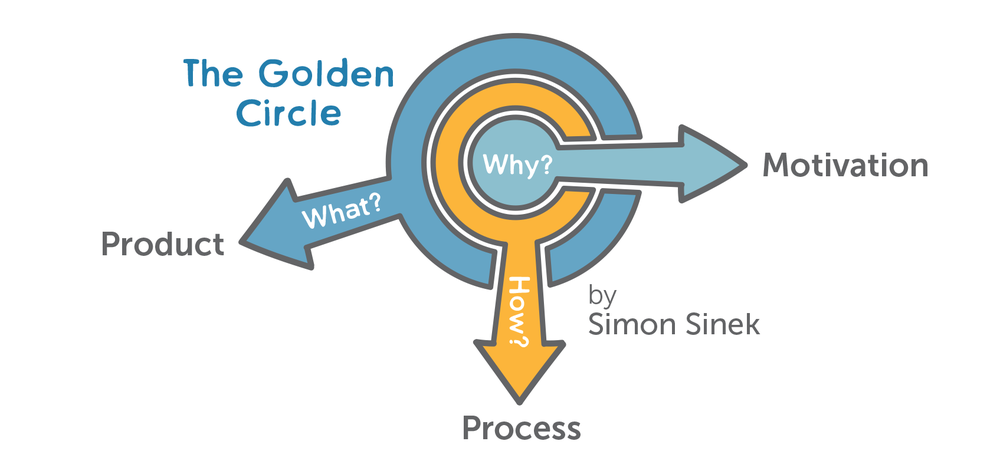
Simon Sinek's work and his 'Golden Circle' theory has really helped our school (and me personally) to think about why we do the things we do. We have spent a lot of time discussing our purpose and trying to develop an institutional 'why'. Understanding that we exist to serve our students and to nurture their emotional, social, intellectual and physical growth has made all of our decisions about how and what we do so much easier to answer. However, as a result of this recent pandemic, my immediate purpose changed: I needed to find ways to support students and teachers to ensure that not only would learning continue, but that we would have systems in place to evidence this learning and communicate it with our families. I have been spending so much time in rethinking the 'how' and 'what' in recent days, I lost sight of the original 'why'.

Well, we are now back at school and things are beginning to settle into new routines. Without the same frenetic pace of remote learning, I now have time to revisit my why. I remember a few years ago seeing a the way in which Sonya Terborg used the golden circle to describe herself as an educator. I also remember Tania Mansfield had mentioned once in a blog post about the need for educators to be brave, to share ideas and make mistakes. And so, inspired by these two brilliant women, I am sharing my reflection about my purpose using the golden circle framework.  
  • Why: Why am I an educator? (Thinking big!)
  • How: How I strive to be the best I can be as an educator (Thinking about the the IB's Approaches to Learning and the Learner Profile)
  • What: What I do in my role as an educator. (Thinking about my day to day - what do people see?)


Tuesday, March 12, 2019

A Marvellous Monday (or...Why I Love My Job!)

I have looked in the mirror every morning and asked myself: ‘If today were the last day of my life, would I want to do what I am about to do today?’ And whenever the answer has been ‘No’ for too many days in a row, I know I need to change something.” ~ Steve Jobs 
Do you ever have one of those days that just flies by, leaving you a wee bit exhausted, but thoroughly happy? It all started with a student saying to me, "When I grow up I want to be a technology teacher, like you." Such a simple statement, but it really stopped me in my tracks and made me think, and I held on to her words throughout the day. What is it that I actually do? I know it's very easy for me to get caught up in the busy-ness of school - there is just so much going on - and often I feel like I'm running from one thing to the next, but as I thought about my whirlwind of a day, and about all of the different experiences I was invited to share with students and teachers, I realised how fortunate I am in my role as a technology coordinator in a primary school. It's been such a great day that I felt compelled to write about it!

So, what did my Monday entail? After our morning assembly, where we share news and celebrate community happenings, I had the first hour of the day set aside to work on the yearbook. As the yearbook club's supervisor, I wanted to check in with the students’ progress using our online editor and ensure that we were on target. As I was reviewing pages, a colleague came in to ask about the possibility of creating a stop motion video of his students drawing, in a presentation similar to an RSA Animate video. While this was an impromptu visit, I was happy to set aside the yearbook and excited to see what we might be able to do. We  pulled out an iPad (I knew our O’ Snap app would work well) and started to prototype possible solutions. After playing with some ideas and materials, we created a mount for the iPad out of duct tape, metre sticks and clamps. I loved visiting his class later on in the morning to see the students drawing in small groups underneath the stations they had built.


After this, I was booked to help a Year 5 class (I have a flexible schedule and teachers book me and/or the Creation Station as needed) to use PixlrX on their Chromebooks. As a part of their How we express ourselves unit, they were learning to manipulate images to create portraits inspired by the work of Andy Warhol. This lesson was followed by a quick briefing during the recess break and a much needed coffee. 

Following the break it was time to help out with the launch of the Year 6 PYP Exhibition. The teachers had invited guests to speak to the students about their passions and how these led to taking action in a variety of ways. My role was to organise a Skype conversation for one of the guests speaking to us from China. I loved hearing the students' questions as they asked about what motivated our speaker to take action and how he dealt with set backs. 

Monday lunch break means Minecraft Club! Always a fun-filled time as children from different year levels come together to play and build. I have learned so much from my students during these club sessions. Lunch is also a time for colleagues to drop in and see me if they need help with anything, and so I had a chance to explore the settings in Spelling City to help troubleshoot an issue and learned a little more about a programme that some of our teachers are using. 

After a quick bite to eat, I was off to a collaborative planning meeting with the Year 4 team to look at possible ways to integrate technology to enhance their current unit. After a quick chat (and a selfie!) I was back upstairs to the Creation Station for a Year 3 class. We are applying what was learned during their simple machines unit to a design challenge using WeDo Lego. Their challenge - to collaboratively build a Mini LegoLand Amusement Park (and I must confess - possibly my most favourite unit of all time!). 

Finally, Mondays after school is Montessori Model United Nations time. I volunteer to coordinate our MMUN team of 11 students from Years 5 - 7. Currently, we are finishing up our position papers on issues ranging from global climate to the rights of peoples to self-determination. For many of our younger students, this is the first time they are having to write using a specific formal style and we are using EasyBib to create our MLA citations.

Some people might read this and think, 'Yeah, you had a busy day. So what? We all do.' And this may be true. But today I really felt the difference our own perspective can have on a day. I could have been busy, just run off my feet and glad for it to come to an end. But, instead, I appreciated each moment and was able to stay present in each of them. How many jobs provide you with a chance to play, build, communicate, collaborate, mentor, learn and have fun all in the course of one day! And so, when I responded to the student who wants to become a technology teacher,  I told her that I think it’s the best job in the world!

Sunday, September 23, 2018

What if...

I never teach my pupils; I only attempt to provide the conditions in which they can learn.
~ Albert Einstein

It's an exciting time to be a PYP educator. The greatly anticipated launch of the Enhanced PYP is fast approaching and the past couple of years of preparation have sparked thought provoking discussions with colleagues about our practice and the very nature of transdisciplinary, inquiry-based learning. Our school, like hundreds of other PYP schools, has been exploring how we might best promote learner agency. Through individual study and reflection, to school-wide book studies and discussions, we are striving to re-think many of our practices; To think critically about why we do the things we do and asking if they are aligned with what we know about learning.

Embarking on a Harvard Project Zero course with colleagues, Creating Cultures of Thinking, and reading the book of the same title by Ron Ritchhart, has prompted us to pose a number of questions as we continue to stretch our thinking about how to transform our school.

  • What if schools were designed from the start for learning?
  • What if every decision a school made was viewed first through the impact it would have on learners? 
  • How might this change the dynamic of what happens in such places? 
  • If the aim of of a school is to provide a place in the community where people come together to become “master learners”, would we need a preset curriculum with which all learners had to engage?
  • How would the shift from places of teaching to places of learning change a school?
  • What if the aim of school was to build relationships and nurture curiosity? 
  • What if we focused on providing opportunities to develop powerful learning and thinking strategies? 
  • What if learners determined the content of the curriculum? 
  • What if teachers were more like coaches or mentors?


If schools were designed for learning would we still create timetables that limit exploration of ideas to 40 minutes blocks of time? Would we still group students be age? Would we still be focused on the completion of projects rather than focused on the process?

I feel a sense of being on the brink of great, systematic change and the PYP may be leading the way, helping educators organise schools to ensure they are places of learning for everyone involved.

Photo by Annie Spratt on Unsplash

Wednesday, February 01, 2017

What future for education? A final reflection

"You have to speak your dream out loud." Kelly Corrigan
Well we have come to the end of our course, What future for education? and a final task was to prepare a TED-like Talk to share our vision for education. Based on the reflections from the classes and my personal musings and experience, I shared my thoughts about primary education. The resulting video is cringe-worthy (honest feedback from my son!), but the sentiment is heart-felt. And so, rather than subject any followers of this blog to my video attempt, I decided to share the script as a post. Of course, you need to imagine me talking from a red circle of carpet with a five minute time frame, and hearing a school bell sound at the beginning! 

Bell on Pixabay, CC 0
"A school bell. What runs through your mind when you hear this sound? I’m late for class! Or, time for lunch. I’m sure you can imagine students lining up, chatting with their friends before school starts. Walking in, being greeted by their teacher. Handing in homework. Settling down into their desks, waiting to hear the plan for the day. Reading, math, a language lesson. Maybe a quiz. There will be time for recess, for lunch. There might even be an opportunity to start on a project, being assigned a group and a topic, but students won’t have time to finish because it will be time for the next class. Then the bell will ring again and the teacher will say, ‘Don’t forget about your homework.'

This is an easy scenario for us to imagine because the organisational structure of public elementary schools has not really changed since its inception. Sure, advancements in technology over the past 25 years has challenged us to think about global collaboration and our students' access to information. We may even be more aware of the value of student-centred inquiry and allow for students to engage in the famous Google 20% time, or Genius Hour as it is sometimes called. But at the end of the day, in most elementary schools, that bell still rings and the teachers still organise learning based on the factory model of education.* 

So why is this a problem? For starters, we’ve learned quite a lot about how we learn since the creation of public education.** But do our schools reflect this? 

We know that we learn best when we feel safe. Brain research has shown the interconnectedness of the cognitive and emotional systems of the brain. When students are in a positive emotional state, they are more able to learn. Yet, schools are organised to cause stress. We put artificial times in place, asking students to start an activity only to stop them and then hurry on to the next thing. We have stressed teachers who rush students in order to cover required content before testing students to see if they have learned the material. If students are late or do not complete assigned homework they are often chastised or made to feel badly about their performance. Elementary schools can be places of great stress. 

Photo by Leo Rivas-Micoud CC 0
But, what if we removed the artificial time boundaries? What if we removed assigning homework or mandating content? What if there were no exams? What if schools were designed to be places of inquiry? Places where students could work at their own pace with teachers as mentors? Places where students were empowered to control their own learning?  Elementary schools can be places of wonder and joy. 

We know that the learning environment itself has an impact on student learning. Research has shown that not only the visual stimuli in the classroom, but scent, lighting, temperature and sound all influence learning. Too many of our classrooms today are like office spaces with fluorescent lighting, predictable seating, closed windows. Students spend most of their day in their assigned classroom, only leaving to attend special subjects such as PE or music and for short breaks. Yet, we know this can have a negative effect on learning. Elementary schools can resemble the factory model on which they were based. 

Photo by Brandon Morgan CC 0
But, what if learning spaces weren’t confined to a room? What if buildings were open and allowed for movement of learners? What if there were spaces designed for different purposes? Quiet areas for reflection and research, areas for collaboration and building. Places to pose problems and create solutions? What if the outdoors was a part of the learning space? What if students could decide where they were most comfortable and learned best? Elementary schools can be thoughtfully designed places of creative inspiration. 

We know that the brain filters new information through the lens of our prior experience and knowledge to create new meaning. We develop our conceptual understanding by making connections and challenging our assumptions. Yet, in many classrooms, teachers insist on covering content in a particular order, not giving students the ‘big picture’ until all of the facts have been ‘taught’. Studies have shown that this can impede learning as students cannot retain disjointed facts and details. Elementary schools can be places where content drives instruction. 

Photo by Tim Gouw CC 0
But, what if we invited students to start the learning by asking questions? What if we provoked students to think about big ideas and challenged them to develop their understanding? What if teachers provided formative feedback throughout the student’s inquiry? What if reflecting on learning was an integral part of the process? Elementary schools can be places where the desire to understand drives the learning. 

There is so much we know about learning and most people I speak with agree that we need to change our educational system. We are no longer in need of the human cogs for the 'bureaucratic administrative machine' that Sugata Mitra describes in his 2013 TED Talk, the industrial age is long gone. We can design schools for learning. We can create places that nurture creativity and provoked thinking? What can give children time - time to wonder, to think, to explore to try. Elementary schools can be places that prepare our children to be lifelong learners and confident, capable, compassionate members of our world."

* The notion of the factory model of education was made quite popular is Sir Ken Robinson's TED Talk, Changing Education Paradigms as shared by RSA Animate. This talk provides a quick overview of why our educational system generally looks and functions the way it does and challenges us to think of alternatives to better suit the needs of our children in today's world.

** Many of the ideas shared about what we have learned from brain research are summarised in the Brain Targeted Teaching Model by Dr Mariale Hardiman, EdD at John Hopkins University.

Sunday, January 15, 2017

Week 4: Can schools make a difference?

"There's an alternative. There's always a third way, and it's not a combination of the other two ways. It's a different way." David Carradine

I suppose the hallmark of a good reflection question is one that stops you in your tracks - really makes you think, or as Professor Alex Moore would say, one that challenges your assumptions. Well, this week's reflection task has had this affect on me. My initial response is, of course schools make a difference. I've been a teacher for over 25 years, I must believe that what I am doing is worth while and has some kind of impact on the lives of the children I work with. After listening to this week's lectures and completing the readings, I have come to realise that I am not sure if schools do make a difference, especially those organised in a traditional manner.

School Bokeh by Ryan McGilchrist on Flickr CC BY-SA 2.0
Can schools make a difference? This is such a broad question I feel the need to narrow it down a bit and preface my own response, understanding that I am making broad generalisations. When talking about a school I am referring to those that are most typical (if there is really such a thing), but those with classes organised by grade or year level, with homeroom and subject teachers. A place where students are assigned to a class and expected to meet specific outcomes or standards before being promoted to the next year level. An organisation with a set curriculum, whether it be national or international, inquiry-based or some other pedagogical approach. While I know there are many different types of schools, all of which vary greatly depending on specific context, generally this descriptive framework applies to a certain extent.

This week's lectures in What Future for Education? were based on an interview with Dr Jane Perryman, who began by describing what we might mean by a good school. Her stance was that such a school would enable students to do better than they expected they could do and that this is such an individual thing, that an ideal school would be different for different people. How can we possibly measure the effectiveness of schools if the ideal school needs to be different for different students? With the invested interest of governments in the success of their schools, there will inevitably be attempts to try and standardise schools, which in turn ultimately means that schools try to become the same as they are measured with the same assessment tool. Her examples focused on the UK's Ofsted inspections and the impact it has had on schools in Britain. Her findings suggest that the negative impact of such school inspections greatly outweigh the positive effects.1 In fact, when asked if it made a difference what school a child attended, she asserted it was not as important as how a child was raised.

So, do schools make a difference? I think they do in some circumstances. My very first teaching position was in a remote, northern community in Manitoba, Canada. The school (there was only one) was an important part of the community. The school had dependable heat, electricity and running water, all of which were not certainties in the homes of the students. The only library in town was the one in the school (remember - this is pre-internet and Google days!) and it provided books not only for our classes, but also for a home reading programme. Through school activities, such as sports and music, students had opportunities to travel to other communities and meet students from other schools. I believe that this school did make a difference to the lives of the children in that particular community. In a community that was marginalised, where many of the families lived below the poverty line, it enabled students to learn more about the world outside of their town and provided a safe place where the community could come together. In a way this school is similar to the community school described in Mark Smith's article for Infed. It was an integral part of the community and used by all, but there was little in the way of curricular innovation or democratisation. Its foremost purpose was to educate the children in the community and that curriculum was dictated by the province.

From here I moved on to the city and a teaching position in a private school. The majority of the students came from very wealthy families and success at school, and then moving on to university, was an expectation. The parents were very 'hands-on' and greatly involved with every aspect of school life. The focus at such as school was really on student achievement, and back then, in the early 90s it was a wonderful opportunity to explore inquiry-based teaching and learning. In fact, it was in this school that I was first introduced to the IB's Primary Years Programme. My students were lovely and my colleagues rather amazing. I loved being in a collaborative environment and trying new things.

During this time I had a friend teaching in public school. We would often talk about the differences between our schools and the challenges she faced that were simply not an issue where I worked. My school was not inclusive, the students were selected based on a series of entrance requirements. I did not have to deal with behaviour issues or students with great challenges to their learning. I remember feeling it was all so easy. My friend was quite passionate about her work and believed her school was making a difference in her students' lives. I couldn't really say the same. I was  quite convinced my students would have done well at school, no matter the teacher, no matter the system. They would do what was necessary to go to university and select the career path they most desired.

5/365 by Anna Gutemuth on Flickr CC BY 2.0
As my own children got older and we began to travel to other countries, experiencing as a family different schools and systems, I began to see that, too often, student success was not because of the school, but despite it. I saw cases of inspirational teachers, but not inspirational schools. Archaic homework practices, heavy work loads, working in isolation and fearing the repercussions if something was not done the way a particular teacher wanted it done, I found myself saying to my own children, you just have to get through this (assignment, course, teacher, year) and then when you graduate you can begin to have control over what you decide to do. School became something to be endured and if you survived you would have the opportunity to choose what would come next. Perhaps time for a gap year to discover what inspires you or what area of further study you might want to explore.

I want schools to make a difference - as both a parent and an educator. I've been struggling with the notion of what a school should be for a few years now and this week's reflective prompt has helped me clarify my thinking - at least in so far as to recognise that this is a very complex issue. Can schools be different for different people? Do schools have to be the same? How might we measure their effectiveness? What do we mean by effectiveness? We tend to measure things that are easy to measure, but perhaps in education, the things that are important cannot be measured easily.

As luck would have it, I came across this image a couple of days ago on Facebook.


At the end of the day, these are the qualities I hope my children (and my students) will embrace and continue to develop throughout their lives. Schools are located all over the world and in all types of circumstances, but what if they were all places where students had opportunities to explore and discover and not worry about grades or exams? What if schools devoted time for students to uncover their passions? What if we nurtured curiosity and looked at each child as an individual and worked with them to plan their learning, based on their own passions and needs? There is time enough for developing expert skills and knowledge once students are older and have a better sense of what they would like to take further.

This week's reflective prompt has raised more questions than answers, but I know now with greater certainty that our traditional school system does not work. There must be a different way.


1 During the interview Dr Perryman referred to her own research that suggests that Ofsted inspections can cause great stress for teachers and school leaders as a poor evaluation may mean a loss of jobs and students being pulled from schools. Such high stakes often encourages schools to prepare for inspection, making decisions based on what is best for a good evaluation and not necessarily what is best for the school or students. Another issue with the Ofsted system is the variability of the inspection teams and the personal bias that is brought into an inspection. She also found fault with the notion that 'value-added' by a school is ignored and that factors such as the socio-economic background for the school's population is not taken into account.

Sunday, January 08, 2017

Week 3: What makes a good teacher?

"I've learned that people will forget what you said, people will forget what you did, but people will never forget how you made them feel." Maya Angelou
Maya Angelou's words resonate with me, especially when I think about the teachers I have encountered over the years - as a student, a parent and as a fellow educator. In last week's reflection I talked about my two most memorable teachers - one whom terrified me and the other whom I loved. These memorable moments in my education were not created due to lesson plans or set curricula, and I don't remember particular things they said or did, but rather I remember the way these teachers made me feel - about myself and school in general.

And so, this week, when asked to reflect upon, What makes a good teacher? my initial response is to say teaching is about the capacity to build relationships. I know however that this is a simplistic reaction from the heart, in reality teaching is more than any one person's personality and skill set as it is takes place in the real world, within a sea of complex issues. Everything from the country in which we teach and the socio-economic backgrounds of our students to our own ideas about what education is meant to be and the philosophy of the school have an impact on the way we approach teaching and learning. So, where does one begin in responding to this type of reflective prompt?

Our lectures this week in What Future for Education? centred around interviews with Professor Alex Moore, author of The Good Teacher. He did not believe this was a question we can answer and quoted Deborah Britzman saying that teaching '...is an ongoing, endless process of becoming.' He suggests we would be better served focusing on good teaching and what this entails rather than thinking there is one archetypal good teacher we should all strive to be. In his book, Professor Moore refers to three discourses, or ways of understanding, what a good teacher should be: The competent craftsperson, the charismatic teacher, and the reflective practitioner.

The use of criteria to assess teaching performance is very common and if you are an educator you have no doubt encountered such tools. Often they will use rubrics to classify teachers from novice to master in a series of different competencies, such as planning and preparation, the classroom environment, instruction and professional responsibilities.1 While there is nothing wrong with wanting to clearly articulate some of the many skills that are important to teaching, there is a tendency by some to think that if all of these skills are in place then you are there - the Master Teacher - no need to learn anything new. It also infers that that is all there is to being an effective teacher, as set of skills that once mastered makes you a good teacher. This discourse does not usually include qualities like empathy and kindness, but rather focuses on measurable skills such as communication and student management.

The discourse of the charismatic teacher is most popular in film and television depictions. These teachers connect with students and understand them, which in turn engages the students and enables them to learn and achieve. While this idea has merit in the necessity of teachers to try and know their students, to appreciate their individual needs and the context in which they live, Professor Moore believes this to be a dangerous discourse as it seems to suggest that a good teacher (or good school) can 'fix' any of society's problems. It can perpetuate a notion of a 'saviour teacher' who will reach the deprived children and make everything alright. The other problem he notes with this discourse is that new teachers who try to be like these types of teachers will not succeed and be left feeling inadequate.

Moore's last discourse is the Reflective Practitioner. This is the discourse I am most comfortable with as it aligns with the idea that teachers are lifelong learners who are continually striving to become better at what they do and have a positive impact on their students. While this discourse is gaining ground, and as an IB PYP teacher, reflection is an integral part of my practice, Professor Moore notes that we need to be careful when we define what reflection actually means. Often, teachers are asked to reflect as an evaluative process at the end of a lesson or a unit, but are not given the time to carefully consider what this means and how they might do things differently to improve next time. In order for reflection not to become another checkbox at the end of teaching, it must be 'future-oriented'. Meaningful reflection should focus on what we are going to do differently next time and what will the impact of this be on student learning.

In The Good Teacher, Moore suggests that we need to take reflective practice and develop it further into what he calls, reflexive teaching. Reflexivity asks us to challenge our assumptions and think about teaching and learning within a wider context, the complexity of the classroom and society. Challenging assumptions is a very difficult thing and cannot be done alone, the need for collaboration as a part of reflexive practice is paramount. Being a reflexive teacher asks us to be open and honest about what we do and how we interact with students. It challenges us to face our assumptions and to focus on the needs of our students. It is a process of becoming, a continual evolution, there is no end point.

What makes a good teacher? Well, it is quite obvious that I am drawn to the discourse of the reflexive (or reflective) practitioner. One of the great assets of working in an IB school is the central role of the Learner Profile in all that we do. I believe when we talk about good teachers, we can turn to these attributes as a framework to assist our reflections.

Good teachers strive to be:
Inquirers - continuing to learn about teaching and learning, researching and wondering about their craft, sharing their enthusiasm for learning with their colleagues and students.
Knowledgeable - about their subject, about issues and the world in which they and their students live.
Thinkers - using critical and creative thinking to design learning engagements that will engage and challenge students; analysing students' learning to assist with their next steps;
Communicators - who listen to students and provide clear feedback for learning; they share their insights with students, parents and colleagues.
Principled - treating students, colleagues and parents with respect and dignity; act with integrity and honesty, and treat students fairly.
Open-minded - they appreciate that their students and families come from diverse cultures and backgrounds and are open to leaning from different points of view; while understanding themselves and their own beliefs are will to grow from colleagues' different approaches and ideas.
Caring - they see their students as whole people and care for their well-being. They show empathy, compassion and respect to students, parents and colleagues.
Risk-takers - approach uncertainty with confidence and are willing to explore new ideas and innovative strategies; they integrate appropriate technologies into their practice, even when they are not experts in its use.
Balanced - maintaining a work-life balance to achieve well-being for themselves and others; modelling for students the importance of caring for all aspects of their lives and our interdependence on others and the world in which we live.
Reflective - being objective in self-assessing our practice and learning from it; becoming aware of our strengths and weaknesses in order to improve and, as a result, have a positive impact on student learning.

I want to be a good teacher and I know this will be an ongoing process. I do not expect to ever arrive at an end point, declaring, I am done, I am now the best teacher I can be. Rather, I see becoming a good teacher as a journey with series of pit-stops along the way to reflect on my practice and its impact on others. Our school has been focusing on the mantra, Know thy impact, which is a fitting way to begin 2017. I hope in ten years time my students will look back an remember our time together with a smile. I hope they remember that I cared about them and shared my enthusiasm for learning.


1 These examples are the domains outlined in the Framework for Teaching by The Danielson Group.

Thursday, December 29, 2016

Week 2: What is intelligence & does it matter?

"Everybody is a genius. But if you judge a fish by its ability to climb a tree, it will live its whole life believing that it is stupid." ~ Albert Einstein

I hated my Kindergarten teacher. She was a drill sergeant of a woman who expected compliance from her students, something of which I've never been particularly good. What made me such a terrible student at five years of age in the late 1960s? I would not nap, play house or sit still during the bible story. I insisted on playing with the blocks (Doesn't she know those are the toys for boys?) and I wanted to read the picture books (She's too young to read!). She believed my deviant behaviour was a sign of a lack of intelligence and wanted me to repeat Kindergarten. Thankfully, my mother had other ideas, fought the school on this decision (ultimately changing schools) and I was allowed to enter Grade 1. 

I loved my Grade 1 teacher. I can still remember being upset when I would wake up for school only to discover it was Saturday and I couldn't see Miss Travers. In Grade 1 we were allowed to read the books (although I have to say Dick and Jane were not that exciting) and I remember the centres Miss Travers set up in the classroom where we could explore things she had brought in and make crafts. She was kind and cared about us; I was never afraid and did not run away once! 

What a difference a year - and a teacher - can make to the life of a student.

This week in the What future for education? course we've been asked to reflect on the following:
  • During your own education, how has your "intelligence" been assessed?
  • How has this affected the educational opportunities you have been given?
  • What judgments have people made about you that have been affected by an assessment of your "intelligence"?
  • Do you consider yourself to be a "learner"? why?
My education was rather typical for a child growing up on the Canadian prairies in the late sixties and through the seventies. Every year we would sit through tedious multiple choice tests, that at the time, I never really gave much thought. As a child, I never made the connection between the tests and the idea that I was being judged on intelligence, I suppose I was blissfully unaware. Luckily, I was able to proceed from one year to the next until graduation and then on to university. Did I work hard - no. Was I inspired - no. I just did what I had to do to get through it - my education was something I had to endure until I was an adult and could take control over my own learning and pursuits.

I think I was an inquisitive learner before I started school. I then learned how to play the school game - be quiet and do what was asked. It took a number of years to see myself as a learner once again. I stumbled into the field of education and became a teacher. It was through my students that I slowly uncovered the joy of learning again. I cringe when I think back to some of the things we were expected to do when I first started teaching, weekly spelling tests, math drills, round-robin reading. But I always remembered how Mrs K and Miss Travers had made me feel and I was determined to be like the latter. I wanted to know my students, to know what they were thinking and feeling so that I might be able to help with their learning. And so I feel becoming a teacher enabled me to become a learner once again.

Why would I call myself a learner? I believe I've grown into a practice that aligns with the three principles of learning that Professor Gordon Stobart referred to in this week's lectures:
  • the learner makes sense of the material (sees the big picture)
  • the learner builds with what is already known
  • learning is an active and social process
I am in a continuous loop of inquiry that is exploring how we can transform education to enable all children to uncover their passions, develop their abilities and come away knowing that we are all learners - that's just what humans are (seeing the big picture). My questions change and evolve as I learn more about one area and this of course begins a new cycle of inquiry (building on what I know). I wonder why things are the way they are, look at possibilities, try things with my students and colleagues, reflect upon these experiences and then make changes based on feedback and results (an active and social process). 

When I reflect upon my own experiences as a student what strikes me is the power of an individual teacher to make a difference in the life of a child. What if each year of school had been like my first? When we think of intelligence as a 'thing' - a 'fixed mindset' - we are closing doors for our students. Perhaps without realising it, teachers who believe this make decisions in their classrooms that will have profound effects on their students. Stobart refers to these as multipliers, small events that over time have a big impact. Luckily for me, I had a few Miss Traverses along the way, who understood that intelligence is not fixed, but rather something that can be nurtured and grown. 


Sunday, December 25, 2016

What future of education?

"I have no special talent. I am only passionately curious." Albert Einstein

I have been thinking a great deal these past few months about education as an institution and how frustratingly slow it can be to make significant changes. I can't help but wonder how schools would be different if they were actually designed to support students and learning, rather than to make it easier for teachers and administrators to organise and remain 'accountable' for their daily practice. And so, with the question 'What if...' playing on a loop in my mind, I've embarked on a personal mission to understand why schools are they way they are and what we might do to bring about meaningful change. What if schools were designed as places of learning? What if schools were places where students were at the centre of every decision?

It is within this context that I came across Dr Clare Brooks' MOOC, What future of education? offered by the University of London & UCL Institute of Education via Coursera. I see this as an opportunity to critically reflect on my own ideas about education and refine some of my questions to drive future studies. As a part of this course we are being asked to keep a reflective journal, and so I am dusting off my blog. Hopefully this will be incentive to get back into the reflective habit! 

Week 1: How do we learn?

This week we explored some of the differences between traditional and progressive approaches to education. I feel quite fortunate to work in a school that embraces inquiry-based, concept-driven learning that understands the importance of reflection in the learning process. The idea that there are still schools where this is not common place saddens me. I do not think of these ideas as being progressive, they may have been so in the 60s and 70s, but not now. With all of the brain research conducted in the past two decades and what we now know about mindsets and motivation, I am at a loss as to why our schools still look the way they do. Even most of our 'progressive' schools that allow for different learning preferences and encourage children to reflect on their learning and set personal goals are not organised in a way that is student-centred. 

Most schools are still organised into the traditional classroom model - one teacher and a large group of students. Educators decide on how these classrooms will be organised: Into which class each student will be placed, with which teacher each student will work, how many minutes in each class, what will be taught and how students will demonstrate what they have learned. Even if the teachers are committed to student-centred learning, most are working within a system that is designed to empower the teachers in the community, not the students.

And so my question remains, How can we recreate schools that are organised for students to best learn? How might schools become places that nurture curiosity and help children to uncover their passions; places where students are empowered to direct their own learning and where teachers serve as facilitators and mentors, providing guidance and opportunities for students to be challenged.

Many people roll their eyes once I get going on this subject. I can almost hear them saying, "Here she goes again. It's just not practical, how would we know what students have learned? How will they get into a university?" Fortunately, not all think along these lines. There are some schools out there making significant systemic changes. Harrisburg Freedom Elementary is one such example. They have removed grade levels and have implemented a new system to empower students through a personalised learning environment. Quest to Learn is a secondary school that has taken a game-based learning approach to provide students with an environment in which they are the designers, innovators, problem-solvers and inventors. While both these schools have taken a different approach, they both understand that the traditional school model does not work. As educators we need to be brave and try new things to ensure that all of our students have an opportunity to learn and become aware of how they best learn.

I'm not sure what future schools will look like, but I know they will be very different from what they are today. We need a paradigm shift in our understanding of 'school'. I just hope we don't need another 17 years of the 21st century to pass before this happens.

Saturday, July 09, 2016

Inquiry + Lego + Scratch = Magic!

"We only think when confronted with a problem."*
~ John Dewey

Last year when our parent association provided us with 12 sets of WeDo Lego I was over the moon, knowing that the students were going to love working with this material as they explored simple machines during a unit of inquiry. And it was fantastic - the kids loved it, the parents and other teachers were impressed by the complex creations the students had built and I was thrilled with the compatibility to Scratch which allowed them to programme their mini-robots.

But (and there is usually a but when you jump right into something new!) I wasn't as happy as I thought I would be. After thinking about the experience with the students I realised that it was just too prescriptive and I questioned how much the students had actually learned. They followed directions really well and built some very interesting machines, but there was nothing creative about the process. There were no challenges to solve (except perhaps for a few of the programming aspects) and I honestly do not think it deepened their understanding of how simple machines worked or why we might use them.

This year I vowed to do things differently. While I love using Lego and I knew the potential was there for some highly engaging learning experiences, I had to reconsider what I was doing in my limited time as a technology teacher with the students. I went back to my roots and approached the unit on simple machines as I would if it were my own class, embracing inquiry and project-based learning.

With their homeroom teachers, my Year 3 (Grade 2) students explore the central idea: Humans use their understanding of simple machines to serve a variety of purposes, learning  about simple machines, how they work and what they might be used for in our daily lives. After some initial research[1], I created a project that I hoped would extend and deepen this understanding through our once a week technology lessons using WeDo Lego and Scratch: We would build an amusement park for Mini-Lego people!

I had been using the Engineering Design Process with older students and thought that this might be a good invitation to the project. After an initial discussion about what an engineer does, we decided it was important to learn about the materials they would be using as engineers in the project and so, the first step was some free exploration time. Our first lesson was devoted to playing with the Lego pieces, experimenting, asking questions about what they might do, trying to make things fit and work. Many of the students quickly made connections to the simple machines they had explored in their classrooms and some of the students with previous Lego and Scratch experience recognised the motors and sensors. I was already happier than the previous year's experience with the level of discussion and the willingness of the students to take risks and help each other.

During out next meeting students formed engineering teams to test the effect of gears on a wheel and axel. Using this presentation, we had a guided exploration of some of the key pieces they would need for the eventual project task. I owe a debt of gratitude to Tim Ewers, whose lesson on WeDo Robotics in the Classroom formed the basis of our tests. Students built a simple propeller, programmed it to run using Scratch, and then observed and recorded the effects of changing motor speed and adding different gears. At the end of the lesson we shared our findings and discussed how this information might be useful to us as engineers when designing and building something.

Our next meeting built on the ideas from the previous lesson, now with a focus on pulleys and belts. I decided that it would be helpful to build one of the Lego Education projects to give students some experience in following directions and seeing how the WeDo pieces can fit together. The Dancing Birds project was a great fit as it introduced not only the pulley and belt, but also the crown gear to the students, while reinforcing the use of axles and gears. Again, students worked in their teams to collect data about the effects of using different types of belts and pulleys and at the end of the lesson we shared our findings and continued the conversation about what we had learned as engineers.

It was now time to introduce the project, time to become Amusement Park engineers! We shared what we already knew about amusement parks, why people might go there and what a good ride might look like. Using this presentation, I shared the task with the students:
You are an amusement park engineer. You have been asked to work in a team to design and build a new ride for the Lego Mini Amusement Park. 
Then, the students and I developed the following success criteria that we added to the slide:

Your ride must:

  • Be built using Lego
  • Fit at least one Lego mini figure
  • Move
  • Be programmed in Scratch to move automatically
  • Include at least one simple machine

We discussed some possible rides for our amusement park and then students formed new teams based on their initial ideas of what they may want to design. The groups looked at books and pictures of amusement parks and then sketched their ideas for their own rides. After sketching, students were asked to think about how they might build these ideas using Lego and this often led to a redesign, especially for some of the more elaborate ideas.

Once a team's design was agreed upon by the group, the building, testing and tinkering phase began. Without a doubt, this was my favourite part of the entire project. The students began building and immediately started testing their ideas. They were trying things and when it didn't work, they would try something else - showing great determination as well as flexibility their thinking. Students listened to each other, learned from each other and helped other teams when they discovered how to make something work. My role during this phase was really one as a co-learner, working along side the students. I am not a Lego expert and for many of their problems, I did not know the answer and so we learned together. It was an amazing experience!

The building, testing, tinkering lessons carried on for a few weeks and the level of student engagement never waned. In fact, every week I was insisting that students stop working and go for their lunch break - I'm sure they would have stayed in working on their rides all afternoon. Before we put all of the rides together into our Mini Amusement Park, students had an opportunity to share their rides with their classmates in a brief presentation. They explained what they had built, the challenges they had faced and what they did to overcome them. If a team was still having problems, their classmates had an opportunity to share possible solutions. At the end of their presentation, students also shared what they would like to do if they had more time or if they were to approach this project again. Afterwards, students had the remainder of the class to refine their rides before placing them into the amusement park. I was very pleased to see that many of the students took the ideas and suggestions from their classmates to fix or improve upon their creations.

Upon reflection I would have to say that this unit was certainly one of the highlights of my school year, if not my entire time as a technology coordinator. While still a guided inquiry, there was a freedom to the project that allowed different students to approach the task in different ways. The expectations were high, but every student was able to participate and experience success. It was a time of authentic and meaningful collaboration, and I know without a doubt that learning took place. But I think what impressed me the most about this project was the students' sense of accomplishment at working through the design process and creating something on their own - it was an empowering experience. The look of pride on their faces when teachers, parents and secondary school students were drawn into the room to see their amusement park was priceless. I think my students summed it up the best when I asked them what was the hardest thing about this project they answered, 'Building our rides using Lego.' and when I asked them what was the best thing about it was, they answered, 'Building our rides using Lego!'

Our Finished Amusement Park

Acknowledgements

[1] The idea of an amusement park project was sparked by reading, The Playground: First and Second Grade Curriculum Unit on Programming and Robotics by Amanda Sullivan et.al., in The DevTech Research Group of Tufts University. Some of the key ideas from their paper resonated with me and what I was trying to achieve with my own students, especially the use of the Engineering Design Process and inviting students to think like engineers.

* This quote is a summary of Dewey's views and according to Quote Investigator cannot be traced to any one work.

Friday, January 29, 2016

Planning for Effective Technology Integration in the PYP

"Our goals can only be reached through a vehicle of a plan, in which we must fervently believe, and upon which we must vigorously act. There is no other route to success." Pablo Picasso
I've always loved exploring the ways in which we can use emerging technologies to support and enhance student learning and as a PYP teacher I was given considerable freedom to develop units in which to embed these technologies. Through reflection, with the students and with our teaching team, we were able to assess which digital tools had the greatest impact on learning and how we might apply them to other areas of the curriculum. The conversations were always about learning - not the technology - and this shared understanding enabled us to transform our classrooms.

So the question now becomes, how do we plan for this type of transformation across our school? We have developed a technology skills continuum using the ideas from ISTE and the IB. We discuss opportunities for authentic technology integration at our collaborative planning meetings. We are well resourced, with students in Years 5 and 6 having 1:1 Chromebooks, in addition to iPads, mobile Chromebook carts and a technology room with laptops and desktop computers. We have robots and Lego, LittleBits and Makey Makeys. And yet, the actual student experience in many classrooms has not changed - I'm afraid we may have fallen into a trap of what Alan November referred to as 'Spray and Pray': "Spray" on the technology and then "Pray" there is better learning.

So, now what?

It was time for a reality check and to look honestly at where we were with technology integration. I know there are fabulous things happening in many classrooms, and while some of them were being reflected in our curriculum maps, there was no way to tell which strategies and practices were having a positive impact on learning. Last year our professional learning focus was about 'stretching' students, thinking about how differentiation can facilitate the development of higher order thinking for all students. What if we could apply some of these strategies to technology integration? That's when I remembered the SAMR model. Dr. Ruben Puentedura developed this model to help educators effectively integrate technology into their teaching and learning. Kathy Schrock's Guide to Everything has many useful links to explore the model further, but this video by Common Sense Media is one of my favourite introductions.


We decided to develop a reflection tool using the SAMR model to help us better understand how technology was currently being used by teachers in all aspects of their practice. We then want to look at how we might be able to make changes to move up the ladder, from enhancement learning experiences to more transformative ones. In this way we can allow for individual teachers to move at a rate that is accessible for them: From Substitution (or no use) to Augmentation, or Augmentation to Modification. By providing a ladder of development, all of our teachers will be able to reflect on their practice and gain from the framework.

My hope is that this will spark some focused conversations during our collaborative planning that go beyond decisions about what apps or devices might be good to use in a certain unit. I'm hoping we dig deeper and look at our pedagogical practice and ask ourselves how are we transforming teaching and learning experience in our technologically rich environment. And more importantly, how can we plan for this to happen in a sustained and reflective practice across our school?

I would love to know how schools are dealing with this issue. Do you use the SAMR model to help? Another framework? Any suggestions would be most appreciated.

Post Script: I found this amazing post by Krista Moroder after I finished writing this...back to the drawing board?

Readings that informed & inspired this post:
Why Schools Must Move Beyond One-to-One Computing, Alan November
Instructional Coaching: Driving Meaningful Tech Integration, Allison Park on Edutopia

Image Credit: Away-Junction-Direction by Peggy_Marco on Pixabay, CC0 Public Domain

Tuesday, January 26, 2016

Magical Minecraft

"If we all could see the world through the eyes of a child, we would see the magic in everything." ~ Chee Vai Tang
It was my daughter who first introduced me to Minecraft. I could hear funny crunching sounds and the occasional tinkling of glass coming from her computer and when I looked over to see what she was doing I was struck by her focus and obvious excitement as she worked. I asked her what she was up to and after waiting for her to 'finish just one more thing' she very happily launched into an explanation of Minecraft and a tour of her creation. While I admit I felt a little queasy after the roller coaster ride through her village, I was intrigued by the virtual space and hugely impressed with what she was doing in it. She invited me into her world and we've been playing Minecraft together ever since.

That was four years ago and at the time I was teaching a Grade 4 class in Hong Kong. When I asked my students how many of them knew about Minecraft, the majority of my students chuckled as they informed me that they played 'all the time.' It didn't take long for me to realise that this type of immersive game would be a wonderful learning platform. Our school already had a Minecraft club for older students and so I was most fortunate to have some knowledgeable colleagues to talk to about the possibility of using Minecraft with my students. We created an initial project aligned to a math investigation, which was a great success and this led to further explorations and an action research project about gaming and student engagement for my SUNY Certificate of Educational Technologies course.

I was a total convert. I would have loved to set up a Minecraft world for my class to use throughout the year - a virtual sandbox to explore ideas, collaborate, play, build, solve problems and compliment the work we undertook in our physical classroom. But, instead, I moved (new country, new role - been there, blogged that) and Minecraft took a back seat while I adjusted to my new context.

Then last year I was chatting with one of our new students in Year 3 and quickly learned of his passion for all things Minecraft. He loved that I knew what Minecraft was and it wasn't long before we were sharing stories about our favourite projects. While on playground duty I learned about his experiments with redstone and when he joined our computer club I learned about his server and his current challenges. When I told him about how my class used Minecraft when I was a class teacher he asked why weren't using Minecraft at our school. Hmm...why not indeed!

With the support of our school administrators we were given the green light to introduce MinecraftEdu as a learning tool in our Primary school. The server was installed in December and we had time to introduce it to the teachers before launching it with the students in January of this year. Being an advocate of Minecraft I was a little nervous as I wanted my colleagues to love it as much as I did. Our initial session was a bit flat, and in fact, one of the teachers felt quick ill from the jerky movements on the screen. There did not seem to be much enthusiasm for the project and I'll admit I felt a stab of panic. Then, a few days after the lackluster session with the teachers, one of them agreed to bring her class in to test it out - just to make sure the server was working when we had everyone online at the same time. That was the golden moment - the "Oh - now I get why teachers like Minecraft!"

There was a range of Minecraft expertise in the class, from students who had used it regularly for a couple of years to others who had never played before. We paired the experts with the novices and in a matter of minutes not only were all of the students in the tutorial world, they were using the chat function to ask questions and teach others how to do things in the space. They were collaborating to solve the challenges, laughing and learning - it was fabulous!

We are now well into our unit using Minecraft as an integral part of the learning and all of the participating teachers are keen to see how we can continue to use it. We are just scratching the surface, but I know this is a pebble that has caused ripples. Teachers who have walked by while the Year 4s are working on Minecraft have stopped, just to watch. Some have come back to ask about using it with their students. We will be introducing a Minecraft club soon and our coding club is planning to experiment with programmable turtles.

I'm so glad to have Minecraft as a part of my teaching and learning world again. There are so many new facets to explore - from ComputerCraft and engineering with redstone to survival mode tactics and crafting. I'm looking forward to learning right along with my students and marvel at the magic of Minecraft.

ps - I'll be sharing our Year 4 projects in a future post.

Monday, January 18, 2016

Learning is in the Journey

"You can't wait for inspiration. You have to go after it with a club." ~ Jack London
On Friday I had an interesting conversation with a group of Year 4 students about New Year's resolutions and they had some relevant statistics to share. They informed me that around 25% of people break their resolutions in the first week. I felt the need to confess that I fell into that category as I had not been able to keep my resolution to write a blog post every day. I had made this promise to myself to get back into the habit of reflecting on my own practice as a teacher. Composing a blog post helps me to sort out my thinking and it's an important part of my learning process. I had hoped that the blogging challenge would help me form the habit of writing on a regular basis - not just when struck with a sense of inspiration. So why did I let it drop after only six days?

When trying to explain why I had not kept my resolution, I realised that the blogging challenge resolution wasn't really meaningful to me. The reason I write is to reflect - I need to have a reason to compose a post. While the prompts were interesting, I was more focused on what was happening at school, such as the Year 4 unit of inquiry that will integrate Minecraft as a virtual learning space. The students helped me to see that I needed to revamp my resolution - it had to have a purpose. If I am writing to reflect, then that is what I should do. I should stop worrying about writing daily superficial posts, and focus on reflecting on what we are trying to accomplish at school.

I am grateful to the folks at TeachThought who created the Reflective Blogging Challenge. It did help me kickstart my stalled blog. And I vow that should I ever find myself in a state of writer's block I will go back to their prompts and pick one - I will not wait for elusive inspiration.

Thank you 4b - next post...Minecraft related!

Image Credit: Writer's Block by Sharon Drummond on Flickr CC-BY-NC-SA 2.0

Monday, January 11, 2016

Mentors

"In order to be a mentor, and an effective one, one must care." ~ Maya Angelou in this PSA

Day six of the Reflective Blogging Challenge asks us to consider, "What does a good mentor do?" When I think back over my career I realise how fortunate I have been to have so many good mentors to guide me. Back then, I probably wouldn't have used the term mentor, but rather these people were trusted colleagues and many became friends. I think Maya Angelou's quote sums up why they were effective mentors - they cared. 

Teaching is a challenging profession - it is not the type of job you can go to school to 'learn' and then, voila, you are an amazing teacher. Educational theory and understanding how children learn is important, certainly, but the art of teaching is a craft honed over time. I believe that is why the role of a mentor is so important, though what a good mentor might do would probably look different for different people at different points in their career. 

At times a mentor can be that quiet voice of confidence to let you know that you can do it. A person you can trust and turn to when things don't work out as planned. As a teacher's confidence grows a good mentor might be someone to learn with, to encourage us to try different strategies, to take risks. It might be a colleague who shares their practice with you or plans lessons with you, pushing you just a little farther in your thinking. 

I'm sure I could research and discover the qualities of good mentors and develop an argument about why mentorship needs to be an integral part of teacher induction. However, it is day 6 of the challenge, I've just finished my first day back after the break and I am tired! Before calling it a night however I just want to say thank you - to all of my many mentors... you cared.

Learning Spaces


Day 5: Post a picture of your classroom, and describe what you see–and what you don’t see that you’d like to.
Well it's day five of my blogging challenge and I'm about to cheat a little bit. School starts tomorrow and I have a lot to do after a few weeks off, but you don't want my excuses! This prompt is about a topic close to my heart and I've been doing a lot of reflecting about effective learning spaces over the last year. Instead of rushing through a newly written post, I thought I would 'remix' some of my previous thinking about my journey to explore the learning space I share with my students.

A few years ago I was most fortunate to be able to test out some new furniture in my fourth grade classroom. My students and I had spent a good part of the beginning of the year talking about what an ideal classroom might look like and we used this feedback while putting together the order. The most important thing to them was choice - they did not want to have to work in the same place every day and sometimes they wanted to sit at a desk and at other times they did not. Another key piece of advice was to make it easy to change the room around to suit whatever we were doing - sometimes working in groups, sometimes having individual space and at times, performing and presenting. It was a great success - empowering for the students and quite liberating for me as a teacher. Gone were the days of stressing about how 'I' would set up the room. It became a true collaborative endeavour.

Then I moved to a new school, new country and new role. As a technology integrationist, I found I had inherited a somewhat traditional learning space. A computer lab with desks in a U-shape and a Smart board up at the front. As I got to know the space (and the students and teachers) I found it increasingly difficult to work in this environment. Inspired by the Third Teacher and learning more about the Maker Movement I knew something had to change. I was inspired to write this post in March 2015 and create this presentation to share with our organisation's ICT Think Tank.

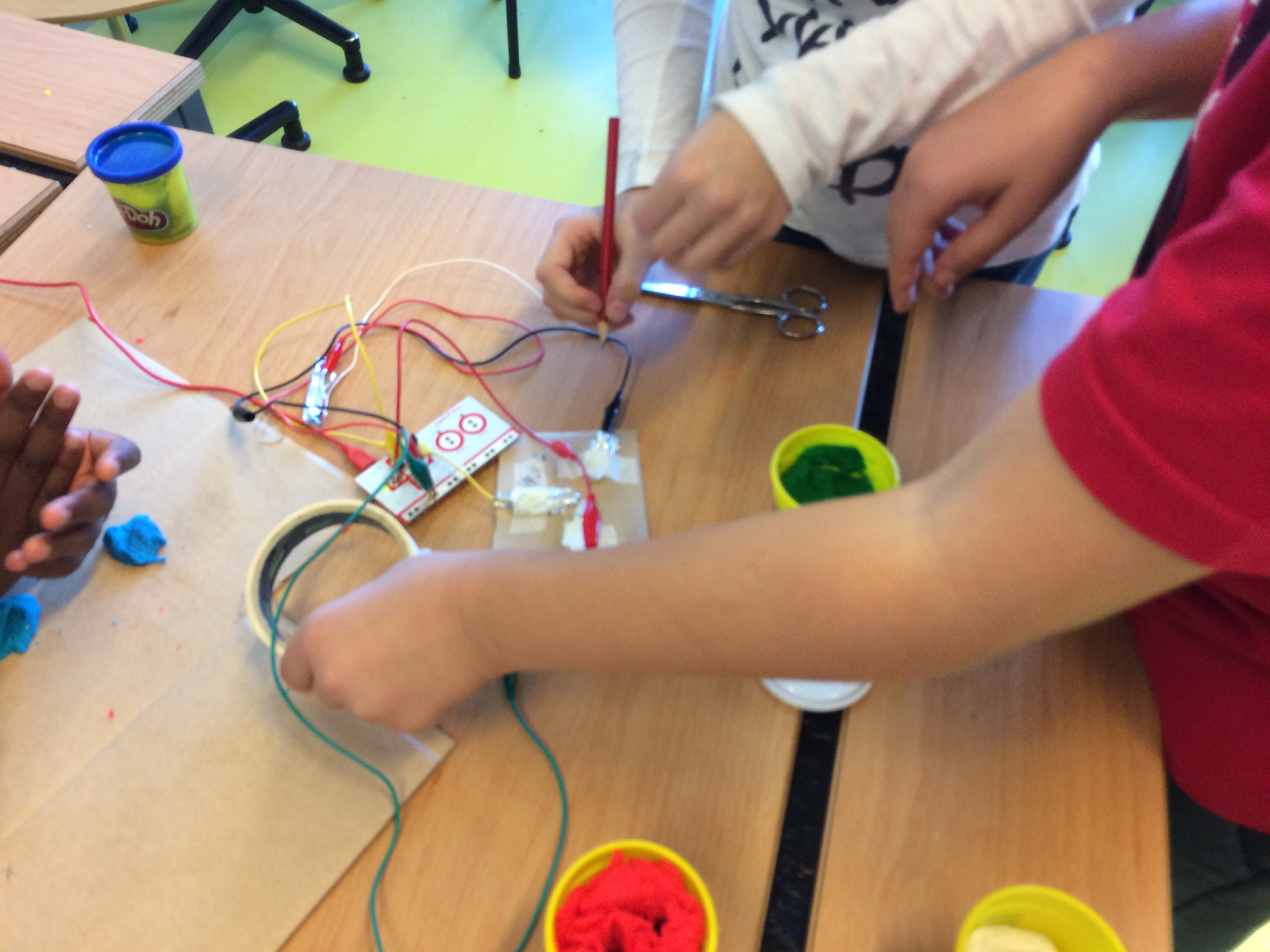
With a supportive administration and some open-minded colleagues I have been able to make some significant changes to our learning space. Gone is the old u-shape computer lab - in fact, half of the desktops have been removed to allow for more open, flexible use of space. We supplement with Chromebooks, laptops and iPads. We have introduced Family Fridays where students can come and explore the materials and resources we have invested in with their families. Teachers are now beginning to see the space in a new way - no longer a computer room, but a 'creation station' (we're still testing possible names!). We have groups using Makey-Makeys to explore circuits, students programming with Scratch and WeDo Lego and others testing out possibilities with Thymio robots. We are about to embark on a unit of inquiry using Minecraft as a learning space and will be using the more open space to build physical structures. We've made great progress.

I realise though as I write this that I have not done a very good job in taking pictures to document the transition. A new promise to myself. Oh - the original prompt asked for a photo of our classroom - there is one of the old computer lab in the presentation that was shared. I plan to take a new one tomorrow when I get to school and update this post (I'll do a bit of a 'side-by-side' comparison).

As promised...