Thursday, April 19, 2012

Student Led Learning Reviews

Tell me and I'll forget; show me and I may remember; involve me and I will understand.
~ Chinese Proverb
 

Today is one of my favourite days of the school year. It is the day when our students share their learning with their parents. Travelling from class to class I see parents listening to their children as they explain the different elements of the programme; demonstrating skills they have acquired; performing and sharing their challenges and successes. Our Student Led Learning Reviews (SLLR) empower our students more than any other school event and I am so proud of my students ~ they shine!

When I first began teaching this was a time of the year I would dread. Report cards about students were written by teachers and then discussed with parents. The adults would then decide upon next steps for the student to ensure continued progress. The person at the centre of all this was not at any time expected to be a part of the process. Innately it bothered me ~ I knew it was not about learning, but it was the way things were done. Thankfully, things have changed.

Earlier in the year we conduct student-led three-way conferences, where students share their portfolio with their parents, discuss their goals and create an action plan to achieve these. This coming together to discuss the learning needs of each child is an essential part of the process. Not only does it set the stage for personalized learning, it encourages children to take charge of their own learning, with their parents and teachers’ support. With such active involvement, students are acutely aware of not only what they are doing, but why they are doing it.

I challenged my students this year to think of creative ways to share their progress with their parents in a way they could not do at home. After all, if their parents were taking time off work to come to the school for an hour-long session, it should be worthwhile and not something that they could have done at home with their portfolio and computer. We developed the following guidelines as a class:

  • Must be relevant - shows your learning 
  • Must be an activity that needs to be done in the classroom 
  • Interesting or entertaining ~ engaging 
  • Show your growth in all of the essential elements and the subject areas 
  • Must share progress toward achieving goals - with evidence 

And rise to the challenge they did! Here are some of the amazing ways in which my students presented what they know, understand and are able to do.

One made a Jeopardy game with the answers relating to our various investigations and her knowledge, conceptual understanding and skill development. Another made a similar game, but did so in French illustrating growth in a second language communication skills.

One boy created a board game that had spaces designated as concepts, knowledge, skills, attitudes and action. He made cards to accompany each category with questions, statements or definitions as well as a special die with a different transdisciplinary theme on each face. Using a regular die to move on the board, you pick a card related to the space you land upon. You are then required to connect what is on the card to the transdisciplinary theme rolled.

Another student had his parents build a unit of inquiry, explaining the process using examples from our previous units to illustrate his understanding of the PYP as well as his growth in various areas.

Others used the charts in our room with the class created success criteria for different routines, such as reflective writing. They then had their parents write a piece, modeling the process and showing their own work as examples.

To end the each learning review I asked the students to write a blog post with their parents reflecting on what was learned through this event. Articulating what was learned through the learning review was a wonderful way for parents to celebrate and acknowledge their child’s accomplishments and growth. It also provided meaningful feedback to our students, allowing them to set new goals. What did they have to say? Below are quotes taken from my students’ blog posts following their SLLR.

Students:
"Overall this has been a great way to show my learning journey."

"Choosing what activities to create and play with my parents was the hardest part of preparing for my SLLR. I knew what I needed to share, but did not know how to share it."

"The best part of my SLLR was when my parents applauded and commended my effort in the end."

"Preparing for the SLLR helped me better understand myself as a learner by letting me see some of my strengths and weaknesses."

Parents:
"I really enjoyed the 45 minutes and now have a better understanding of how and what he learns."

"The children learned a lot of different concepts, much different and more difficult from what I learned in [school]."

"He is an active learner who now takes a lot more initiative and responsibility in his learning, applying his knowledge to everyday life and other similar situations."

"The best part of SLLR was learning what he is doing in school, learning and growing all the way."

"The most exciting thing we observed was how confident she was. We feel that the format of this SLLR where she had the autonomy to decide on the activities she presented to us led to a more authentic interaction, where she could show us with confidence how she is progressing as a learner."

"She structured the learning review in a fun and interactive manner. She presented each subject as a game or activity where we were able to see and learn about the topics and units she is studying. It was fun to experience her interpretations of her learning and take part in her classroom activities."

"I am impressed by how organized he was during the SLLR process. He was clear in explaining the process and the purpose of each exercise. We created a new central idea together and I was surprised at how well he understood the concepts."

"I got to learn more about how students walk through the unit of inquiries, how they prepare for whatever activity they have to do, how they process the information."

"I loved to see the positive change she demonstrated."
Watching my students prepare for this day and then conduct their reviews with such poise and confidence I really do wonder why we still need to write reports. A piece of paper will never have the ability to capture the authentic assessment and reporting that occurred today in my classroom.
What a fabulous day!

Monday, March 26, 2012

Considering Digital Literacy

The fact is that given the challenges we face, education doesn’t need to be reformed - it needs to be transformed.   
 ~ Sir Ken Robinson in The Element
My last assignment for my CET course was to create a video in response to the following questions:
  • What is digital literacy?
  • What is an area of digital literacy that could be improved upon in schools?
  • How might we improve in this area?
774-Neuron Connection-Pattern by
zooboing on Flickr, CC-BY-SA 2.0
And so, in my effort to worker 'smarter not harder' I have included the transcript from this video below as a post (the video is below).

Our world has changed and the environment students’ live in is vastly different than the one their teachers experienced as children. It is electronic and digital; media rich, fast, engaging and dynamic. By the time our students graduate they will have spent as much time online as a professional pianist would have spent practicing.

Marc Prensky describes this generation as one that operates at ‘twitch speed’. It is their accepted norm to have instant access to information, goods and services at the tap of a screen. They expect to be able to communicate with anyone anywhere at anytime. More importantly, there is strong indirect evidence that these digital natives think differently, that in fact their brains are physiologically different from those raised in the pre-digital world.

And so, as educators we must ask how are we preparing these digital natives, our students, for the 21st century? What does it mean to be digitally literate?

TheInternational Society for Technology in Education, or ISTE, has developed National Educational Technology Standards ~ commonly called NETS, that provide a widely accepted description of the skills and knowledge students need to be digitally literate. These digital literacies have also been defined by the International Baccalaureate (IB) to promote the integration of technology to support teaching and learning in their Primary Years Programme.

Both organizations have similar ideas about the attributes of digital literacy; collaboration, communication, digital citizenship, yet it is the need to create that strikes a chord with me personally. The ability to create, while an important digital literacy, is also a higher order thinking skill. When students are asked to create in the context of real time, creating solutions to real world problems and then share these, teaching others, research from institutions such as the National Training Labs, tells us that the retention of students’ learning is dramatically improved.    

And so the question becomes what do our students need to become creative problem solvers? How have we changed to facilitate this?

In Sir KenRobinson’s book, The Element, he states that the mistake made by many policymakers in education is to believe that ‘the best way to face the future is to improve upon what was done in the past’ (p 235). But we know this is not working – our world has changed and so have its inhabitants. We need to transform our education systems to meet the needs of our digital children.

We need to rethink what learning spaces might look like – do they encourage collaboration – both locally and globally? Do they provide for the use of appropriate tools for our digital age? Do they empower students to create content, solve problems and share their findings, teaching others in the process?

Many educators worry about keeping up with technology – which is understandable as the rate of change makes this a futile exercise. Students today will be better served if we focus our energies on designing spaces that facilitate learning in a digital age. We still teach children and as always, we must consider the needs of people and how to best support meaningful learning.


Works cited:
Churches, A. Educational Origami. < http://edorigami.wikispaces.com> March 2012.

Fenton, J. ADE Application Video. <http://www.youtube.com/5vVNLT5uAc> 2011

ISTE: International Society for Technology in Education. www.iste.org. 2011.

Jukes, Ian & A. Dosaj. “Understanding Digital Children (DKs)” Teaching & Learning in the New Digital Landscape, The InfoSavvy Group, September, 2006. Prepared for the Singapore MOE Mass Lecture.

Prensky, Marc. “Digital Natives, Digital Immigrants” On the Horizon. NCB University Press, Vol. 9 No. 5, October 2001.

Prensky, Marc. “Digital Natives, Digital Immigrants, Part II: Do They Really Think Differently?” On the Horizon. NCB University Press, Vol. 6 No. 1, December 2001.

Robinson, Ken. The Element: How Finding Your Passion Changes Everything. London: Penguin Books. 2009.

The Role of ICT in the PYP. International Baccalaureate Organisation. 2011.


Thursday, March 15, 2012

Building my PLN

The growth of any craft depends on shared practice and honest dialogue among the people who do it. We grow by private trial and error, to be sure -- but our willingness to try, and fail, as individuals is severely limited when we are not supported by a community that encourages such risks. 
~ Parker Palmer in The Courage to Teach, p. 144
I have always been aware of the benefits of developing a professional learning network (PLN); seeking the advice of colleagues and mentors, knowing that there is much to be learned from the collective wisdom of others. When I first started teaching I may not have referred to this collection of people as my PLN, but in fact that is what they had become. Over time, with advances in technology, it became easier to bring my network with me, after all my former colleagues were only an email away, but once the Internet became such an easily accessible virtual space, my PLN began to take on a life of its own, growing at a rapid, and at times, uncontrolled pace.

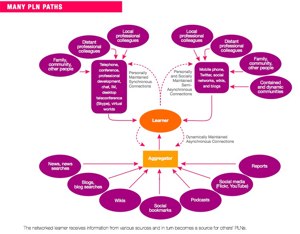
Prior to reading David Warlick’s article, Grow Your Professional Learning Network, I would have described my PLN as consisting of my colleagues (present and former), some Twitter contacts and the blogs I subscribe to and read regularly. I have now become more aware that my own PLN was in fact a conglomerate of three different and distinct networks. The diagram below illustrates the make-up of my current PLN. Inspired by Warlick’s model, I wanted to apply this organizational structure to my own learning groups, trying to better understand how they fit in my PLN as a whole. 

Created with Bubbl.Us

This exercise required me to think more critically about my PLN and I have a much better understanding of the types of learning activities I’m involved in and how these relate to each other. Prior to this reflection, my PLN was a vague collection of people and groups that were maintained in a haphazard manner. I now see the value of organizing my network. I now have a greater appreciation as to why I have had some difficulty in keeping up, feeling a bit over-whelmed by the sheer volume of information coming to me through my contacts. With a better understanding of the different types of PLNs and their ‘avenues of cultivation’ (Warlick, 13) I feel I am better equipped to manage my network. This has been a definite area of improvement to my PLN. I no longer feel the need to maintain all of my connections with the same level of intensity. For example, I used to spend a great deal of time keeping up with the blogs, wikis and nings I followed, reading and leaving comments as often as I could. Now I realize that it would be more beneficial for me to spend the time developing relationships with people I feel are vital to my learning network, whether they are current colleagues or people I know only through Twitter or as the author of a favourite blog. I will no longer devote as much time to my ‘dynamically maintained asynchronous connections’ as I do my ‘personally and socially maintained semi-asynchronous connections’ as I realize there is not the same need (Warlick, 13-14).

With this better understanding of PLNs and their potential impact on my own learning, I would like to now purposefully cultivate my connections to better meet my needs. Thinking about how I can use a network to connect, communicate and collaborate with others about areas of particular interest will help me attain a greater focus (Novak). I plan to introduce Diigo as a tool to help with this refinement of my PLN. I also believe my PLN will be more effective with some weeding, removing those connections that no longer suit my learning needs. While I will always maintain relationships and participate in various community groups (both virtual and face-to-face) I will not necessarily include everything in my professional learning network. I think as my purpose becomes more clearly articulated, the more effective my professional network will become.

Works Cited
Warlick, David. “Grow Your Professional Learning Network: New Technologies Can Keep You Connected and Help You Manage Information Overload”. Learning & Leading with Technology March/April 2009. 18 February, 2012.

Novak, Bev. “If you don’t have a PLN, you don’t know what you’re missing”. Connections: a newsletter for school librarians. Issue 80. Education Services Australia. 18 February, 2012.

Sunday, March 04, 2012

Evaluating Web 2.0 Tools

The most serious mistakes are not being made as a result of wrong answers. The truly dangerous thing is asking the wrong question.
~Peter Drucke

For a recent assignment in my Certificate of Educational Technology course we were asked to review three Web 2.0 tools and evaluate their worth to teaching and learning. A fairly straight-forward task and quite pertinent considering we make these kinds of decisions regularly in our classrooms. We had reference material to guide us, such as the revised Bloom's taxonomy and the NETS from ISTE, but I also wanted to see what others do ~ how do other educators decide which tools to use to support and enhance teaching and learning.  When I began this search I was surprised that I could not easily find many examples of evaluation tools available to educators. I compiled what I was able to find using Storify.


One of the most challenging aspects of this task was deciding upon the three tools to evaluate. How to choose, with so many available? So, I started with the obvious, the Web 2.0 tool my students and I use on a regular basis, Google Docs.

Description: Google Docs is a set of free online tools that allow you to create, edit and view your documents, spreadsheets, presentations, forms and drawings from any computer or smart phone. All of these documents allow for real time collaboration and have privacy settings that allow you to control who has access to view and or edit the document. Simple to use and easy to download to your own computer or embed in another site, such as a blog or wiki.

Digital Literacy Value: While Google Docs can be made private and edited and viewed by only one user, the digital literacy value is in their ability to support collaboration, allowing groups of people to communicate and work together to create one document. When student groups use Google Docs to collaboratively inquire, they have opportunities to conduct research and apply critical thinking skills while sharing, analyzing and synthesizing their data. These are also authentic opportunities for students to develop their digital citizenship skills; learning how to treat others in a virtual space, respecting others’ contributions and using online sources ethically. I also love the fact that it helps our classroom to become a 'paperless' environment.

Examples of Use: My students have used Google Docs to support collaborative inquiries during smaller investigations to collate data and then to prepare reports, which allows me to provide feedback to the students on their work. Students also used Google Docs to support their investigations when preparing for the PYP Exhibition, which allowed them to share their progress not only with the classroom teacher, but with their mentors as well. I have also used Google Forms to collect information from my students. For example, we use this tool as a regular part of our math classes as a digital exit slip where the information helps me plan for next learning steps. Lastly, I have used the Google Docs and Presentations for professional reasons when preparing to facilitate a workshop with someone who lives in another country. 


The second tool I chose to evaluate was VoiceThread because it is one that has great potential and I haven't used it as effectively as I would like. After preparing this evaluation I have decided to use VoiceThread more often with my students.

Description: This is a wonderful tool to foster collaboration and sharing ideas around a topic or an issue. VoiceThread is like an online conversation where you can upload images and then leave comments about the content. These comments can be typed, audio recordings or video recordings. Participants are also able to draw or write upon the images as they share their comments. The best part about this tool is that participants can listen to comments and then build upon what others have said.

Digital Literacy Value: VoiceThread can be used in various ways that would support students’ digital literacies development. Using a teacher created VoiceThread could provide students with opportunities to analyse and evaluate content. They would need to understand the comments left by others and build upon this, justifying their own opinion. Having students create their own VoiceThread to show their understanding of a concept would require them to apply their knowledge in a different context.

Examples of Use: I have recently used VoiceThread with my students as a means for collaborative groups to share the central ideas they created with their classmates. Students had a set of success criteria and were trying to decide which of the statements best met the criteria and should be included as entries from our class in the larger ‘voting’ process for the Exhibition central idea. More recently we have used this tool to support a conversation about small group animations the students have completed for a unit of inquiry. We will be using the comments left by students as a mean of assessing their understanding of our central idea.


The last tool I selected for this assignment was Storify. I've not yet used it with students, but I've always liked the idea of compiling socially constructed information to tell a story. 

Description: This tool allows you to search social media such as Twitter, Facebook, Flickr, Google and Youtube to build a story around an issue or topic. Easy to use, you simply type in the subject you would like to explore and select which media you would like to search. You browse the links that appear in a sidebar and select the items you wish to include in your own story by simply dragging them into your workspace. These ‘stories’ are then hosted on Storify and you may share the link or embed them into your own site. You may go back later on and update any stories you have created.

Digital Literacy Value: While I have not yet used this tool with students, I have used it myself when exploring an idea. I like it because I am able to keep the sites I come across in various places together in a way that is easy for me to access. By reading a variety of perspectives I build my own understanding of an issue and it is an opportunity to evaluate what others may be saying. If done well, this tool could be used to create a ‘story’ that is either well balanced, showing multiple perspectives, or if your purpose is to persuade, deliberately biased toward a particular view. 

Examples of Use: I’ve created stories to capture my explorations of Twitter and the flipped classroom model and most recently, Choosing the ‘Right’ Web Tool. I found it helped me to read a variety of posts and view videos in a more focused, purposeful manner as I had used a ‘guiding question’ in the description of my story.


The real power of this exercise was not in my own evaluation of three Web 2.0 tools, but in the sharing of our thoughts in class. The resulting compiled list of tools, with my colleagues' annotations has become a most valuable resource and I would highly recommend such an endeavour.

Friday, February 17, 2012

Inquiry as a stance: revisiting ideas


“...inquiry is a collaborative process of connecting to and reaching beyond current understandings to explore tensions significant to learners.” ~Kathy Short

One of the first books I read about inquiry was Learning Together Through Inquiry. It was in a sense the book that propelled me to look more critically at what I was doing as an educator, which ultimately led me to the IB and teaching in an international school. So when I recently read, Taking the PYP Forward  I was excited to see that it was Kathy Short who had written the first chapter ~ quite fitting, I believe.

Inquiry as a stance on curriculum outlines the key features of the inquiry model developed by Short and Harste in 2002, addressing some of the common misconceptions about this ‘authoring cycle’ and clarifying what this model might look like in practice. Revisiting these ideas that are at the heart of inquiry practice has been a great reflective prompt for my own practice. 


It is natural (I would argue essential) that our practices change over time. As a PYP teacher, reflecting on teaching and learning is an integral part of the planning process, seeking to find ways to better facilitate student learning. As we attempt new approaches or concentrating on improving a particular aspect of our teaching, we often let go of practices that have become routine. But just because something has become routine doesn't necessarily mean it is an ineffective practice.

While reading Inquiry as a stance I found myself thinking, 'Oh, yeah - I used to do that' and wondering why I stopped. The best part about becoming more aware of what I am actually doing, or not doing, is that I can make small changes very quickly. I have found when I purposefully make such changes I am much more focused on the result or impact of the change and thus in a better position to reflect on my own practice. 


Reading this article reminded me of the importance of allowing time for learners to build on their conceptual understanding ~ not rushing to 'unpack a central idea' or make connections to the 'transdisciplinary theme'. While tuning in to our most recent unit of inquiry, I made sure we had opportunities to explore the concepts before making any connections to the theme, and all of this well before sharing the central idea. The students were so engaged and the connections they made to the unit once introduced were so strong, that the invitation to inquiry was a natural next step. 


Student created movie trailer exploring understanding of concept causation. Click here to see others.


Reflection is an essential practice for effective teaching and learning and we must make time for it. Unfortunately, this critical practice is often forgotten, or left until the end of a unit ~ a way to 'wrap-up' a planner. On-going reflection, focused and purposeful is a habit I must develop. I want my next 'Oh, yeah' moment to be 'Ah - that's why I do this!'


Sunday, February 05, 2012

Managing Time ~ Realistically

The business of reflection in determining the true good cannot be done once and for all... It needs to be done, and done over and over and over again, in terms of the conditions of concrete situations as they arise. In short, the need for reflection and insight is perpetually recurring. 
~John Dewey
I must preface this post with an apology for taking so long to write - I cannot actually believe that my last entry was at the beginning of October! It is not fair to say I've been busy - every teacher I know is exceedingly busy and yet many of them manage to write articulate, thought-provoking and at times, inspirational pieces regularly in their blogs. So, what happened? More importantly, how shall I remedy this?

In an attempt to 'work smarter' I am trying to bring the different aspects of my current context together. I cannot add the continual update of my class blog to this endeavor (which is a labour of love that I will always find time to maintain), but I can aim to focus my professional activities; a bid to stop spreading myself too thin and to participate more actively in my professional learning network.

What am I involved in? 
One of the most time consuming activities educators face is keeping up with professional reading. There are just so many fantastic books and articles ~ and I love to read! What I found difficult was remembering where all of the great ideas were coming from - Was it in this article? That book? So, I began a professional reading journal that would help me to remember the key points and my thoughts about the reading. A helpful idea for me, but another time consuming task that did not lend itself to sharing and learning from others' thoughts about the material.

As a PYP teacher and workshop leader, I am also continually reflecting on my practice and thinking of ways to capture what inquiry based teaching and learning looks like in the classroom (my students are the most wonderful participants in this undertaking!) The creation of videos and reflective journals again takes time and while I was documenting what I might be doing, it didn't really help me to expand on this. What are other teachers doing? How are they approaching inquiry in their classes? How can we share these experiences?

Finally, I've decided to participate in a course with colleagues and work toward a Certificate in Educational Technology. Another amazing learning opportunity ~ being able to share and explore with colleagues, thinking critically about the ways in which we integrate technology in our classrooms and develop digital literacies - highly engaging conversations. Again, incredibly time consuming, but more importantly - how can we share the conversations with a wider network? Learn from the collective wisdom of our shared learning communities?

Bringing it Together ~ a potential solution
Professional reading, personal practice and coursework - how to align these practices and bring them together? And then it hit me ~ through my blog of course! I sometimes can't believe how hard it is to see the easiest of solutions. Why have I been separating all of my professional work, creating separate writing tasks, when I have a blog? This is even more embarrassing as I am an advocate of blogging; often talking about the value of this practice both for teachers and for students? And so, taking a moment to reflect on my practice (ironic isn't it!) I am now 're-inspired' to continue with my blog.

Next post ~ soon!

Thursday, October 06, 2011

Reflecting on my Goals

Courage doesn't always roar. Sometimes courage is the quiet voice at the end of the day saying, "I will try again tomorrow."
~ Mary Anne Radmacher
I recently attended an EARCOS workshop with colleagues to begin the process of developing an action plan to assess the impact our technology initiatives are having on our school community. While this was a worthwhile event for our team, the biggest ‘take-away’ for me was the personal spark for reflection. As we worked through the steps in creating our action plan, one of the guiding questions stood out - What do you expect to see? A simple little question that stopped me in my tracks.

At the beginning of this school year I set some goals for myself to try and create a classroom that resembled a collaborative problem solving studio. I had some ideas in my head about what I might do and a vague sense of what this would look like, but I didn't develop any concrete plans or devise a way of assessing my progress. What did I expect to see? It's a great question and one I didn't really ask myself when I first started to think about changes I would make in my practice.

So, what do I see everyday? Am I really looking? Or have I fallen into the busy trap of doing what needs to be done in order to ‘complete’ units in time to be in step with my colleagues. It's time to take stock. What have I done? What do I plan to do? How will I know if my classroom is becoming more like my vision of a collaborative problem solving studio? What do I expect to see?

I decided to make a list of the types of things I would hope to see if I walked into such a learning space.
  • Animated students working together in small groups on a variety of projects and investigations
  • Students writing on their blogs about their inquiries, collaborating with students from other countries
  • Purposeful noise - the kind of buzz that is generated by happy people engaged in meaningful work
  • A sense of freedom and flexibility as everyone used the space and resources as needed
  • Me, the teacher, working with a group of students as a collaborator
  • A welcoming space, one where students would invite visitors into their conversations, keen to share and open to learn from their experience
Do I see these things? Without any evidence or collected data it is hard to say. From my subjective viewpoint, these are the things that are working. I know I try to dedicate time for students to pursue inquiries of personal interest, but to be honest, it is the first time I steal from when interruptions (holidays, evacuation drills, assemblies...) make it difficult to get to all of the learning engagements I had planned (I know - the 'I have planned' part is a part of the problem!). I am trying to use technology to make effective use of our time in class. I have joined the Flipped Class Network and have just completed my first 'flipped' lesson (awkward and way too long, but my students liked it!). My students are using their blogs to write about their learning and to host our first attempt at digital portfolios. How well am I doing at writing comments on all of my students' blogs and monitoring their progress with their digital portfolios, well - this is definitely an area for improvement.

What's not working? I am going to restrain myself from going on and on here, but... I still have students waiting for me to tell them what to do. Many of my students still ask for 'permission' to do the things they need to do for their own learning ("Is it alright if I do this on the computer?" "May I work at the round table?"). Most of the activities in our class are still initiated by me and many of the students are still focused on the 'amount' they need to 'do'. I still struggle with realistic time lines; my class is not an island, but one of five and we work collaboratively with the other classes. How do you allow for individual and authentic learning experiences when you are tied to shared assessments and a common schedule? I still catch myself saying things like, 'Only five more minutes until French - finish up!'

What did I expect to see? How will I know? I've decided to embark on a bit of a project after our mid-term break. With my students help we are going to take a picture of our class every 20 minutes during the school day over the course of a week. What will we see? It will be an interesting analysis and will hopefully help me to become more objective when assessing the progress (or lack thereof) I am making in trying to achieve this shift.

Stay tuned - I'll share when the project is done.