Monday, January 11, 2016

Learning Spaces


Day 5: Post a picture of your classroom, and describe what you see–and what you don’t see that you’d like to.
Well it's day five of my blogging challenge and I'm about to cheat a little bit. School starts tomorrow and I have a lot to do after a few weeks off, but you don't want my excuses! This prompt is about a topic close to my heart and I've been doing a lot of reflecting about effective learning spaces over the last year. Instead of rushing through a newly written post, I thought I would 'remix' some of my previous thinking about my journey to explore the learning space I share with my students.

A few years ago I was most fortunate to be able to test out some new furniture in my fourth grade classroom. My students and I had spent a good part of the beginning of the year talking about what an ideal classroom might look like and we used this feedback while putting together the order. The most important thing to them was choice - they did not want to have to work in the same place every day and sometimes they wanted to sit at a desk and at other times they did not. Another key piece of advice was to make it easy to change the room around to suit whatever we were doing - sometimes working in groups, sometimes having individual space and at times, performing and presenting. It was a great success - empowering for the students and quite liberating for me as a teacher. Gone were the days of stressing about how 'I' would set up the room. It became a true collaborative endeavour.

Then I moved to a new school, new country and new role. As a technology integrationist, I found I had inherited a somewhat traditional learning space. A computer lab with desks in a U-shape and a Smart board up at the front. As I got to know the space (and the students and teachers) I found it increasingly difficult to work in this environment. Inspired by the Third Teacher and learning more about the Maker Movement I knew something had to change. I was inspired to write this post in March 2015 and create this presentation to share with our organisation's ICT Think Tank.

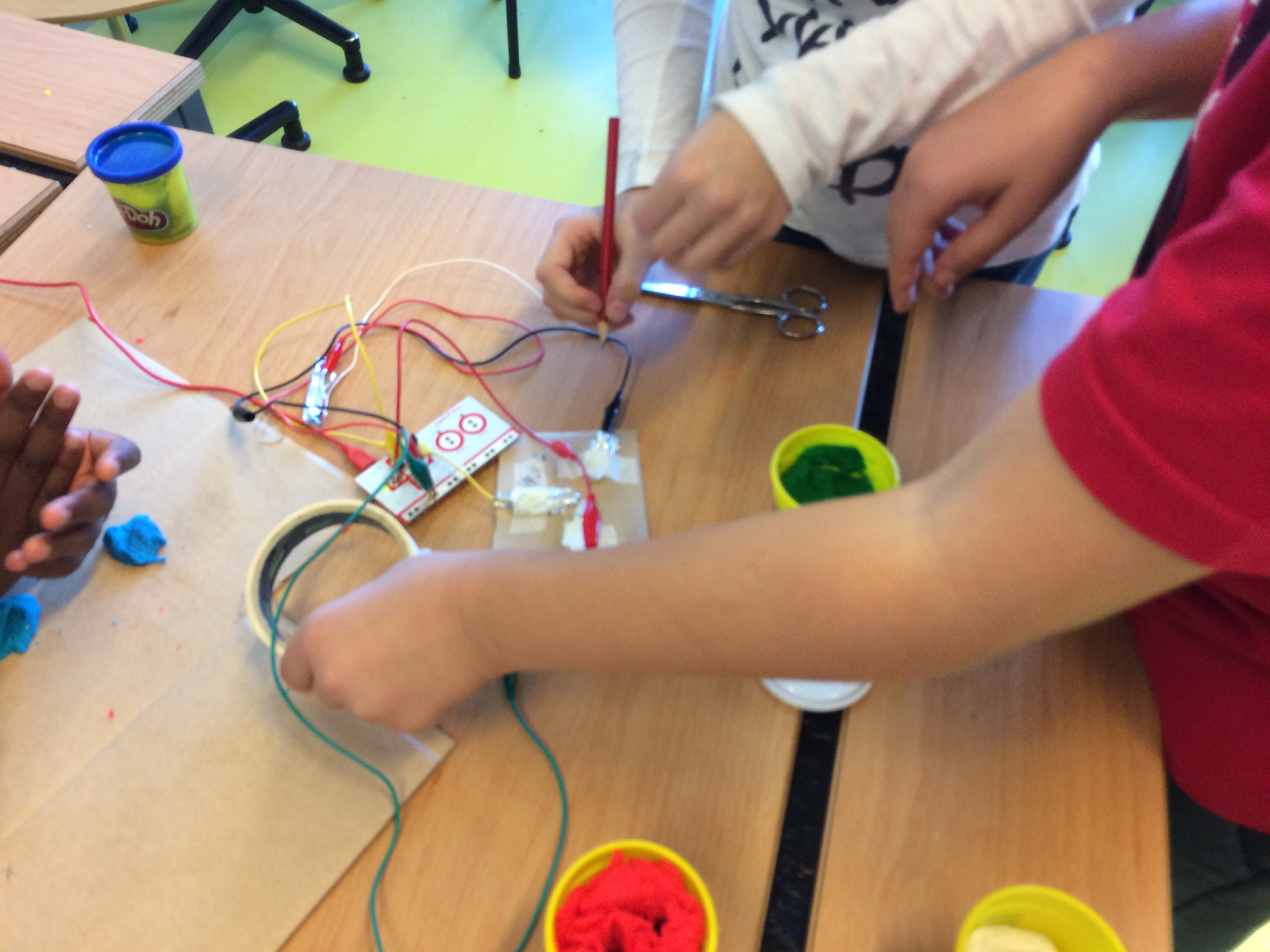
With a supportive administration and some open-minded colleagues I have been able to make some significant changes to our learning space. Gone is the old u-shape computer lab - in fact, half of the desktops have been removed to allow for more open, flexible use of space. We supplement with Chromebooks, laptops and iPads. We have introduced Family Fridays where students can come and explore the materials and resources we have invested in with their families. Teachers are now beginning to see the space in a new way - no longer a computer room, but a 'creation station' (we're still testing possible names!). We have groups using Makey-Makeys to explore circuits, students programming with Scratch and WeDo Lego and others testing out possibilities with Thymio robots. We are about to embark on a unit of inquiry using Minecraft as a learning space and will be using the more open space to build physical structures. We've made great progress.

I realise though as I write this that I have not done a very good job in taking pictures to document the transition. A new promise to myself. Oh - the original prompt asked for a photo of our classroom - there is one of the old computer lab in the presentation that was shared. I plan to take a new one tomorrow when I get to school and update this post (I'll do a bit of a 'side-by-side' comparison).

As promised...


Saturday, January 09, 2016

The do-over


Day 4: What do you love most about teaching?

There are so many things I love about teaching it's hard to settle on just one aspect. Most certainly a big part of why I love being a teacher lies with the students. It is a privilege to be part of great 'ah-ha' moments in children's lives. How many other jobs afford people the time to look at the world through the eyes of young people who are trying to figure things out and are happy to wonder and delight in experiences that for most adults have become 'meh - been there done that' moments.


I also love the opportunity to work with like-minded people (and okay - perhaps a few not so like minded people) to discuss our practice and explore ways of doing things better - for students and for ourselves. An opportunity to think deeply about how our education system works and why it is the way it is. Question it and explore ways to make it more relevant and appropriate for our students.

But I think the most honest response to why I love teaching is because it is a profession that provides 'do-overs' on a regular basis. There's the obviously new school year every September, but there are also new terms, new units, new months, new weeks. Each and every one asking, just begging you to reflect on what worked, what didn't and what would you like to try again? Do differently? I love that I am always learning and that I'm never certain what a day will hold. And if what I had planned didn't work - that's okay, tomorrow is a new day.

Friday, January 08, 2016

Day 3 of the Blogging Challenge

"We are what we repeatedly do." ~Will Durant in The Story of Philosophy, 1924

Day three of the Reflective Teaching Blogging Challenge asks us to, "discuss one 'observation' area that you would like to improve on for your teacher evaluation.' After giving this some thought, I realised after moving into a single-subject role some of my practices changed and I lost a bit of what I valued when establishing a classroom culture or learning community. I think that this may have been a result of learning how to work effectively with many other teachers, accommodating their needs and how to best support technology integration within their classes.

When I was a class teacher I spent a great deal of time ensuring that our classroom was a democratic, shared learning space. Where individual differences were acknowledged and valued and students were empowered to decide how the space would best meet their learning needs. It was an environment that was flexible and open, one that provided student voice and choice, with clear learning intensions. I would like to get back to that type of a space. Where students can make choices about what's next for their learning journey and how I can best support them to achieve their goals.

I cannot escape the reality of needing to provide support for technology integration for the teachers, but I can be more thoughtful about providing different learning paths to enable their students to acquire the skills and knowledge they need. I can also promote a technologically literate mind-set when working with the different classes. I know that once my badging system is operational, it will be a good tool to help support students' personalised learning options. In the meantime, I think I need to think about how I can promote student voice, encourage choice and model a growth mindset.

Thursday, January 07, 2016

Hmmm - where to start?

It feels good to be lost in the right direction. ~Unknown

Day 2: Write about one piece of technology that you would like to try this year, and why. You might also write about what you’re hoping to see out of this edtech integration.

I'm finding day two to be a bit of a challenge - day two!! Perhaps it is because of my role. I am the technology for learning coordinator (love the acronym - TLC) for the primary section of our school and so technology integration is sort of my thing. One piece of technology? How could I ever choose?

Personally, I love new things - apps, gadgets, devices. I love testing out new technologies to see what they might be able to do for students (and for teachers). If I had my dithers I'd try every new technology that was available for me to try. But the reality is there is only so much time in the day and money in my budget and so my explorations need to remain a little more focused. A better question for me would be how do I decide what to promote for integration?

I suppose the most important guideline for selecting a piece of technology to integrate would be purpose. Why introduce something new? For newness sake? I remember a former principal saying that any decision we made as a school should be based on how it would impact the students' experience at school. That was fifteen years ago - I agreed with her then and feel it still holds true today. Any technology we introduce should be to support and/or enhance teaching and learning. Why else would we make the investment in devices and training?

That being said, I believe all students should have access to the internet and powerful creation tools. Many of these tools are web-based, so I think it's important that all students have access to some sort of device that connects to the internet. I think these devices should be readily available when needed (i.e. 1:1 scenario or BYOD). I want to have access to tools that will allow students to create - make and build in both the virtual and real worlds.

But I ramble... So what piece of technology do I want to try this year. I think I am most keen to develop the digital badge system for the Primary section aligned to our Google Apps and the PYP. I would love to conduct a small action research project to see if personalising learning and using badges has a positive effect on student engagement and digital literacy skills. What will it look like exactly? Not quite sure yet. I've made a start at mapping out the badges I would like to roll out, but will know more once I begin using them with the students. I would love any feedback!

There - day two not as hard as I thought. Happy to be back in the blogging saddle.

Image Credit: Possibilities by Geralt on Pixabay CC-0 Public Domain

Wednesday, January 06, 2016

Third Time's the Charm

Fall down seven times, stand up eight.~Japanese Proverb

Another new year and another chance to start again with forming the blogging habit. I think this might be the third year in a row that I have made this promise to myself. Each year I believe I can do it, but it doesn't take long before I realise six months have gone by and I haven't written a word. In this case it's been ten months since posting and I'm not really sure why. I had set time aside in my schedule, though I quickly would give it up and say I was available to avoid the task of composing a post. I had plenty to write about, between exploring ways to use digital badges, introducing coding and WeDo Lego, using Makey-Makeys and Thymio robots with students in addition to some truly inspiring and exciting professional development opportunities I've experienced this past year, finding content was not the problem. So what is it? Why do I always seem to get stuck?

I hate to admit it, but I think it's insecurity. I wouldn't call myself a perfectionist, but I am a rather harsh critic of anything I write. It's just so permanent. I agonise over word choice and struggle to strike a tone that I am comfortable with sharing. Too personal? Too formal? To much slang? To much #edtech jargon? Every time I write an item for the school newsletter I am stressed - I worry about clarity, spelling, grammar, interest, length... and something that should take ten minutes morphs into an hour long ordeal. So I probably shouldn't be surprised that I've managed to put off writing a blog post for 10 months!

So what's changed (this time)? Nothing, really. Just getting up again. Though, each time I fail at this blog I feel I gain a little insight. This time I am going to try and kick start forming the blogging habit with the help of the Reflective Teaching blogging challenge. The name appealed to me ;-) and I know I need some help. So, here goes for Day 1, my hope is after the 30 days I'll no longer need the crutch.

Day 1: My Goals
The original challenge is for the start of the school year, so I am adapting this somewhat to align to my goals for 2016.
So this is it. 2016 is the year I'm going to conquer my writing fears and commit to this blog. No more feeling guilty when students ask me about my latest post or when I talk to teachers about the importance of sharing practices. No more comparing my musings to other educator's blogs. No more excuses. I am going to write to reflect because I know that this is the only way to move forward and become the person I want to be.

Image Credit: Start by JakeandLindsay on Flickr CC-BY-2.0; Goals created with PixTeller 

Wednesday, March 25, 2015

Creating a Learning Adventure for Teachers

"The creation of something new is not accomplished by the intellect, but by the play instinct..." Carl Jung
Our professional learning focus for this school year has been STRETCH; exploring how we can creatively differentiate teaching and learning to ensure all students reach their potential. We've spent much time discussing what this might look like in our inquiry-based programme and the role technology plays in the development of engaging, relevant and challenging learning experiences for our students. Throughout the year we have had opportunities to discuss these ideas, even arranging for all staff to take a week long course on gifted education and higher order thinking. As we began planning for our latest pedagogical development day, we knew we wanted to create learning experiences for our teachers that would put many of the ideas previously discussed into action.

I had recently read a post by Carl Hooker about Making Learning Fun Again - Even for Adults on Edutopia. In it he describes the concept of 'Interactive Learning Challenges' that he used at a learning festival (as opposed to a conference) to replace the traditional lecture driven sessions. These challenges promote collaborative problem solving, creative and critical thinking, as well as authentic integration of technology - a perfect fit for what we are striving to illustrate for our staff development day.

Using this model, we planned our day as a learning adventure. We created a series of open-ended challenges that staff teams would have a set amount of time to solve. Each challenge had an element of technology embedded, either as an optional extension or a core component. The week before the development day, we had all participants identify their comfort level with technology integration on a continuum and this information helped us with the creation of the teams. We wanted people to have an opportunity to collaborate with members of staff they do not normally have a chance to work with in order to continue building relationships and potential curricular connections.

On the big day we all came together to highlight the aims of the development day and share the logistics. We structured the time at each challenge to mimic our typical school day, asking teams to allow for group reflection at the conclusion of each task. The teams of 4 were unveiled, given a 'tool kit' with an iPad and a digital camera and set out to find their starting place by locating and scanning their unique QR code.

It was an exciting day and action-packed day. Teams had a great deal of fun, as well as moments of frustration, but the genuine problem-solving and authentic integration of technology was clearly evident. It was a day of learning. It was a day of Stretch - trying new things and leaving our comfort zones, as can be seen in the tweets shared during the challenges throughout the day.


When we asked the teachers for feedback about this new approach to staff development the responses were very positive.
"It was an enjoyable day.  The group I was put in allowed me to get to know two members of staff who I didn't know very well yet and had not worked with.
"...the Twitter idea was fun and it was interesting to see other group's photo and thoughts through the day.
"I think had we not been prompted by a guided reflection it would have been dropped all together and on least one occasion our reflection from the previous task help in the next.
"I liked the format of the day a lot. I enjoyed the opportunity to work with people I don't always get to collaborate with and to be challenged to think creatively. It was very intense!"
More importantly, the experience of our Interactive Learning Challenges has prompted teachers to consider their own practice and thus, will have an impact on students' learning.
"I will allow the students to spend more time reflecting and time to think."   
"[I have] more sympathy for students who are not in comfort zone but will actually insist more on them finding out for selves as very good for you if a little painful.
"I will think about the timing of activities and about the expectations we place on students to quickly switch from one activity to another.
"Try to use more technology, in more creative ways in my teaching."
If you are considering a new approach to your next professional development day, I would whole-heartedly encourage you to give this a try. It may have taken a great deal of time to create our learning adventure, but the rewards are well worth the effort.

Resources:


Friday, March 06, 2015

The Third Teacher: Creating effective spaces for learning

"In brief, the environment consists of those conditions that promote or hinder, stimulate or inhibit, the characteristic activities of a living being." ~ John Dewey
I have always valued the creation learning spaces that best suit the needs of students and a community of learners. I remember when I first began teaching, sitting in my empty classroom in August and imagining what the room might become. In those early days, these decisions were usually made by me, but as I became more experienced, student voice became a critical piece of the design process for our classroom. I came to realise, however, that our conversations were still chained by the traditional reality of our space. Our classroom was still a single room filled with the stuff of schools - student desks, chairs, boards, bookshelves and so on. While much can be done within such a space - I know my students certainly felt good about the rooms we had created for learning and we all accomplished a great deal - I can't help but feel a bit stuck. How can we re-invent schools without changing (drastically) the structure of the building itself? How can we leave classrooms as they were 50 years ago and think that this arrangement still meets the needs of learners today?

Seeking ways to redesign my current learning space, I began to investigate possibilities. I am most impressed by the Maker Movement (a blog post for another day!) and believe that such an approach best supports inquiry-based learning.
Exploring how we might create this type of learning environment for our Primary students led me to the book, The Third Teacher: 79 Ways you can use design to transform teaching & learning. The opening quote spoke to me:
The child starting kindergarten this fall will graduate in the third decade of the 21st century. All we can know about the world she will step into is that it will have challenges and opportunities beyond what we can imagine today, problems and possibilities that will demand creativity and ingenuity, responsibility and compassion. Whether this year's kindergarten student will merely survive or positively thrive in the decades to come depends in large measure in the experiences she has in school. Those experiences will be shaped by adults, by peers, and ultimately by places, by the physical environments where she does her learning. United in the conviction that environment is our children's third teacher, we can begin anew a vital mission: designing today's schools for tomorrow's world.
After reading this book I am firmly committed to making a change to the space I have some control over - the primary computer room. I am setting out on a journey to transform this room; to build a safe place that will promote student innovation, allow for tinkering and time for reflective design thinking. As I enlist the support of colleagues, I will be sharing the ideas from The Third Teacher and The Maker Movement Manifesto.